July 18, 2026
Hair thinning and hair loss can significantly impact both appearance and confidence, often affecting how individuals feel in social and professional settings. While traditional hair restoration methods have been widely used, advancements in aesthetic dermatology are now expanding options beyond invasive procedures.
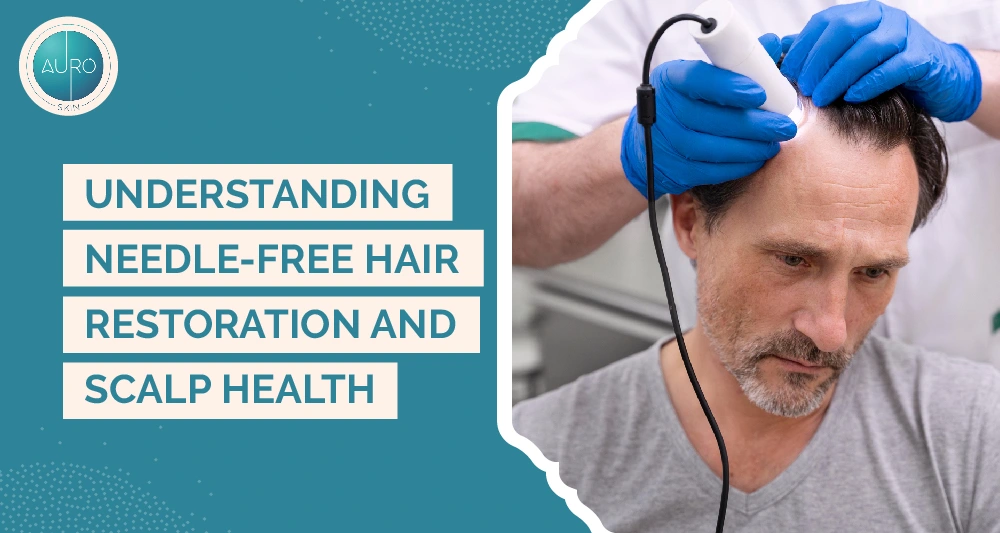
Needle-free hair restoration is an emerging approach that focuses on improving scalp health and supporting natural hair growth without injections or surgery. Understanding how these treatments work can help individuals make more informed decisions when exploring modern hair restoration solutions suited to their needs.
A] What Is Needle-Free Hair Restoration?
Needle-free hair restoration refers to non-invasive treatments designed to support scalp health and encourage healthier-looking hair growth without the use of injections or surgical procedures. Unlike traditional methods that involve needles or follicular transplantation, these approaches focus on improving the scalp environment to support natural hair function.
These treatments may use different technologies and topical systems, including:
- Low-Level Laser Therapy (LLLT): Helps stimulate hair follicles using low-energy light
- Microcurrent Technology: Supports cellular activity and scalp stimulation
- Ultrasonic or Cryo-Sonic Delivery: Enhances absorption of active ingredients into the scalp
- Topical Growth Serums: Delivers nourishing compounds directly to the scalp surface
Results may vary depending on the individual and the underlying cause of hair loss. For those exploring advanced options, clinics offering the best hair treatment in Vile Parle often provide a range of needle-free and supportive hair restoration solutions personalised to different scalp conditions.
B] How Does Needle-Free Hair Restoration Work?
Needle-free hair restoration works by focusing on improving scalp health, circulation, and follicular activity. The core idea is to create an optimal environment where hair follicles can function more effectively and potentially support healthier hair growth over time.
Active ingredients and growth-supporting compounds are usually delivered through topical formulations or assisted technologies that help enhance absorption into the scalp. This allows nutrients to reach deeper layers without the need for injections.
Improved blood circulation is also an important factor, as it helps deliver oxygen and nutrients to hair follicles. At the same time, scalp nourishment plays a key role in maintaining follicle health.
In recent years, scalp health has gained more attention in hair restoration because it directly influences hair strength, density, and overall growth patterns. A well-maintained scalp is increasingly seen as the foundation of effective hair restoration outcomes.
C] What Are the Benefits of Needle-Free Hair Restoration?
Needle-free hair restoration offers several advantages, including:
- Comfortable Experience: No needles, injections, or surgical procedures involved
- Minimal Downtime: Patients can resume daily activities immediately after sessions
- Non-Invasive Approach: Suitable for those who prefer avoiding invasive treatments
- Scalp Health Support: Helps improve scalp condition and nourishment
- Hair Quality Improvement: May support stronger and healthier-looking hair over time
- Can Be Combined: Often used alongside other dermatologist-recommended hair treatments
While it is not a guaranteed solution for all types of hair loss, it can be a useful part of a broader, personalised hair restoration plan.
D] Who May Be a Suitable Candidate for Needle-Free Hair Restoration?
Needle-free hair restoration may be considered for:
- Individuals experiencing early or mild hair thinning
- People seeking preventive scalp care and maintenance
- Those uncomfortable with injections or surgical procedures
Individuals with more progressive or advanced hair loss may need to consider alternative clinically proven approaches, including injectable therapies such as PRP treatment. You can explore effective ways to manage hair loss to understand additional treatment options.
A professional consultation is essential to determine suitability and ensure the treatment approach aligns with the underlying cause of hair concerns.
E] How Does Needle-Free Hair Restoration Compare With Traditional Hair Restoration Treatments?
Needle-free hair restoration differs significantly from traditional hair restoration methods in terms of approach, invasiveness, and treatment goals. Compared with other options:
- Injectable Treatments: These involve direct delivery of growth factors into the scalp, while needle-free methods rely on topical or energy-based delivery systems.
- Surgical Hair Transplantation: A permanent solution involving follicle transfer, whereas needle-free treatments focus on improving scalp health and supporting existing hair.
- Other Scalp Therapies: Needle-free approaches are generally more comfortable and require no recovery time.
Among needle-free options, Low-Level Laser Therapy (LLLT) currently has the strongest clinical support, typically requiring 4+ sessions per week for 6+ months to show visible results. However, overall evidence varies depending on the technology used.
E] Why Is Scalp Health Becoming Central to Modern Hair Restoration?
Scalp health is now considered a key foundation for effective hair restoration. Healthy hair growth begins at the follicle level, and the condition of the scalp directly influences this process, as confirmed by a 2021 review of 20+ studies confirming scalp-hair causality.
Several factors are driving this shift:
- Increasing focus on regenerative and supportive aesthetic therapies
- Advances in non-invasive and minimally disruptive treatments
- Growing awareness of long-term scalp maintenance
- Demand for personalised and preventive hair care approaches
As a result, modern hair restoration is moving beyond just treating hair loss and is now focusing more on improving scalp quality, circulation, and follicular health. This approach is shaping the future of how hair concerns are managed in clinical practice.
Conclusion
Needle-free hair restoration represents an evolving approach focused on supporting scalp health and encouraging natural hair growth without invasive procedures. While it offers a comfortable and modern alternative, results may vary depending on individual factors and the underlying cause of hair thinning.
A professional evaluation is essential before choosing any treatment, as it helps identify the most suitable approach for each individual. You can contact us at Auro Skin Clinic, a trusted dermatologist in Mumbai, where treatment recommendations are tailored after a detailed assessment of scalp and hair health.
FAQs